

Professional Ethical Hacking: Why and When to Hire a Pentester
1. Introduction
Professional ethical hacking is, for many companies, the security investment that is easiest to understand and the latest to be made. Hiring a professional who tries to attack your own infrastructure sounds contradictory, but it is exactly the method mature organizations use to discover their vulnerabilities before a real attacker does. A well-executed Professional ethical hacking engagement answers with evidence the question every board should ask: how would an attacker get into my company?
In this article we explain what Professional ethical hacking is and what it is not, when it makes sense to hire a pentester, how to define scope and authorization, which tests and deliverables the service must include and how to select the right provider. If your company is considering hiring this type of service, here are the technically and legally sound criteria to do it.
2. What Professional ethical hacking is and what it is not
Professional ethical hacking means that a qualified specialist attacks the systems of a company, in an authorized and documented way, with the goal of identifying vulnerabilities and demonstrating how far a real attacker would get. The difference from malicious activity is not in the techniques, which can be identical, but in the authorization, scope, methodology and deliverables. That is the ethical and legal frontier that defines the industry.
It is not Professional ethical hacking, even if it is sold as such, an analysis limited to scanning ports with an automated tool and delivering a list of CVEs without context. Nor is it a service without a defined scope that allows discretion over customer data, or one that does not deliver a prioritized remediation plan. A serious engagement combines reconnaissance, exploitation, privilege escalation, lateral movement within the agreed scope and complete documentation of every finding with technical evidence.
Professional ethical hacking relies on established public frameworks: the testing methodology of PTES, the OWASP Top 10 for web applications and the OWASP Web Security Testing Guide. If the provider you are evaluating does not reference any recognized methodology, that is already a warning sign.
It is also worth distinguishing a pentest from a red team exercise: the first verifies vulnerabilities within a concrete scope and an agreed calendar, while the second measures the detection and response capability of the organization against a realistic adversary. Both have their place, but the starting point of any Professional ethical hacking strategy is always the vulnerability test: there is no point measuring detection if you do not yet know what is exposed.
Many companies only hire this kind of expertise after an incident; the ones that plan ahead use it to prevent one. A pentest should be part of the annual security cycle, alongside the security plan and the training programme, not a one-off reaction to bad news.
3. When to hire a pentester: the decision table
The most frequent question from boards is when to spend money on this. The answer depends on the changes the organization goes through, not on the fiscal calendar. This decision table summarizes the usual cases we handle in companies with which we work on Professional ethical hacking projects:
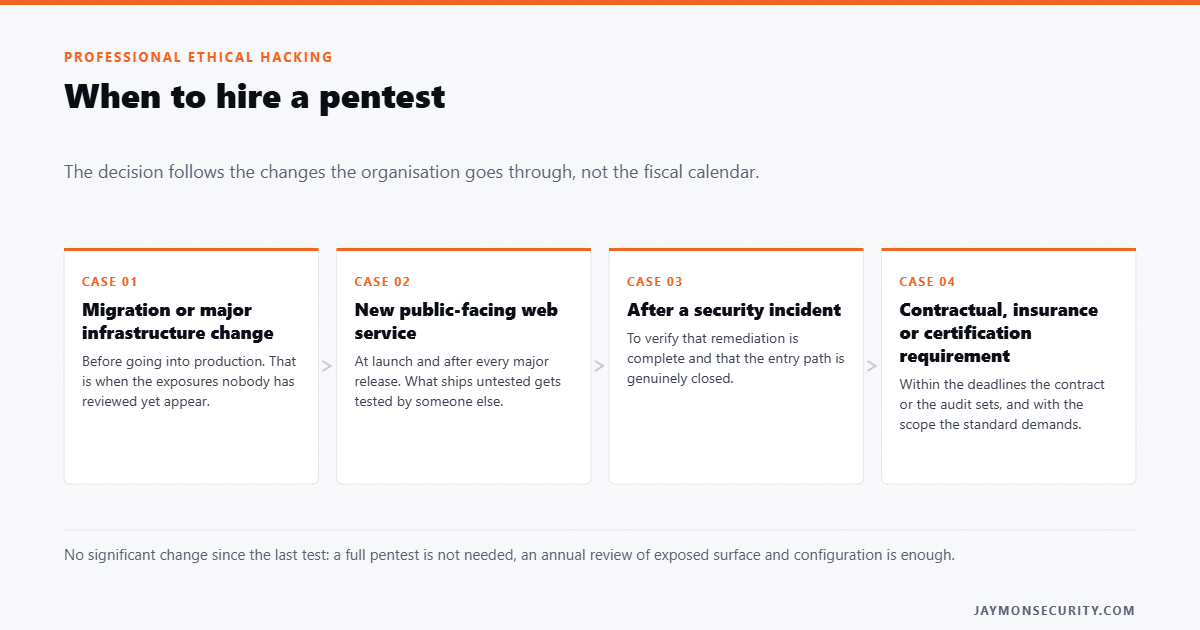
| Company situation | Hire a pentest | Frequency / reason |
|---|---|---|
| Cloud migration or major infrastructure change | Yes | Before going to production |
| Launch of a new public web service | Yes | At least at launch and after every major release |
| After a security incident | Yes | To verify that remediation is complete |
| Contractual, insurance or certification requirement | Yes | Within the deadlines set by the contract or audit |
| No significant changes since the last test | No, light audit | Annual review of surface and configuration |
| Cloud infrastructure with shared responsibility | Evaluate per provider | Review the exposed surface inventory every year |
Fig. 1 – Decision table on when to hire a Professional ethical hacking engagement.
The general rule is simple: every significant change in the exposed surface justifies a test. A web business publishing a new API every quarter needs more frequency than an industrial company with stable systems. Professional ethical hacking should follow the pace of change, not the natural year.
When the test detects a critical vulnerability during the execution window, the provider must have a direct communication channel with your technical team, not just a report mailbox. That fast communication channel is part of the service and must be written into the scope document; in the Professional ethical hacking projects we lead it is standard practice, and it prevents a finding from becoming an incident.
Before the first test, every Professional ethical hacking engagement must have an authorization document signed by both parties. This document delimits the systems to test, the permitted techniques, the time window and the limits: without it, the pentester would be committing a crime and the company would have no coverage. An example of the minimum document would be:
PENTEST REQUEST AND AUTHORIZATION
Client: Fictia Ltd. (VAT GB000000000)
Scope: 62.0.113.8/28 and app.fictia.com (no production data)
Permitted tests: enumeration, SQL injection, XSS, SSRF
Prohibited tests: DoS, social engineering, data extraction
Window: 2026-10-05 to 2026-10-16 (09:00-18:00 CET)
Emergency contact: +44 7XX XXX XXX
VPN access: <provided by the client>
Signatures: [Client CTO] / [Pentest lead]
Fig. 2 – Scope and authorization document for a Professional ethical hacking project.
A poorly defined scope is the first cause of failed projects, both by excess (the pentester touches unauthorized systems and trust is lost) and by default (critical systems are left out of the test). We recommend setting the scope with the asset inventory in hand, explicitly including subcontractors and technology providers when the service depends on them. This document is also part of the evidence that auditors and insurers require.
During the execution window, the provider should report progress at agreed milestones and escalate critical findings immediately through a direct channel. A fifteen-minute weekly checkpoint call is usually enough to keep alignment without interfering with the work. In our projects, this cadence has repeatedly turned an unexpected finding into a controlled fix instead of a crisis.
5. What the service must include: tests and deliverables
A complete Professional ethical hacking engagement covers, at minimum, three layers: network and perimeter, web applications and system configuration. To validate the provider’s work, it helps to know which commands and verifications are expected in each layer. An example of the kind of checklist we apply internally:
5.1. Tests and deliverables of Professional ethical hacking
# Minimum verification checklist (network and web)
nmap -sV -p- --open -oA scan 10.0.3.0/24
grep -c "open" scan.gnmap
sqlmap -u "https://app.fictia.com/item?id=1" --batch --level=2
curl -s -o /dev/null -w "%{http_code}\n" "https://app.fictia.com/admin"
grep -rn "<script>" /source-repo/templates/
unzip -l code-backup.zip | grep -i "config\|\.env"
Fig. 3 – Typical test checklist in a Professional ethical hacking engagement.
The checklist shown is minimal: a mature provider complements it with manual verification of each finding, because automation alone produces noise, not certainty.
The deliverables must include an executive report (risks in business language and priorities), a technical report (vulnerabilities with evidence, reproduction steps and CWE/OWASP references) and a prioritized remediation plan. Distrust reports without reproducible evidence: every finding must be demonstrable, because remediation and any provider claim depend on that demonstration.
Remediation is half the value of the service. A good Professional ethical hacking contract includes a retesting phase: once your team fixes the findings, the provider repeats the affected tests and confirms that the vulnerability has disappeared, issuing a closing letter with the final status of each finding. Without that phase, the report is only a photograph that ages the day it is delivered.
6. How to select a pentest provider
Choosing the provider is the decision that determines the value of the whole exercise. This is the checklist we recommend to companies that ask for support in their Professional ethical hacking procurement processes:
- Documented methodology: PTES, OWASP WSTG or equivalent, adapted to the specific scope.
- Demonstrable experience: real cases in the sector, not just certifications; ask for references you can call.
- Professional liability insurance and a confidentiality clause with defined responsibilities.
- Deliverables agreed in writing: executive report, technical report and remediation plan, with deadlines.
- Post-remediation validation: the provider must re-run the tests after the fixes within the same contract.
- Personal data: processing in line with GDPR if environments with personal information are accessed.
The indicative price of a Professional ethical hacking engagement in Europe in 2026 starts around 3,000-5,000 euros for a standard web test and can exceed 20,000 euros for complex networks with Active Directory. Distrust offers far below the market: they are usually automated scans sold as pentests, or projects where the scope will be reduced along the way.
Before signing, also agree on the project management process: a technical owner on each side, a kickoff meeting where the scope is reviewed line by line, and encrypted communication with an operational emergency contact. Project management is not bureaucracy: it is what separates an orderly Professional ethical hacking engagement from an improvised one, and the difference shows in the quality of the final reports.
Related articles: CTF 1: Jaymon Security ethical hacking and SQL injection analysis and study.
7. Conclusion
Professional ethical hacking is the most direct way to know the real posture of your organization against an attack, and its hiring should respond to changes in the exposed surface, incidents or contractual requirements, not to intuition. Define the scope in writing, demand methodology and demonstrable deliverables, and select the provider by its process, not by its brochure.
At Jaymon Security we help companies procure, supervise and validate complete Professional ethical hacking engagements, from scope definition to remediation verification, with a team of certified pentesters with proven experience in real projects.
Need help with Professional ethical hacking?
At Jaymon Security, we help organizations protect their systems. From security audits to SIEM/SOC implementation, our expert team designs custom solutions.
Contact us for a free infrastructure assessment.


